The Ancient Science of Chaldean Planetary Hours
For millennia across Babylon, Hellenistic Greece, and Renaissance Europe, astrologers observed that time is not uniform or homogenous. Each hour carries a distinct metaphysical quality governed by one of the seven classical celestial bodies: Saturn, Jupiter, Mars, the Sun, Venus, Mercury, and the Moon.
1. The Chaldean Sequence of the Seven Planets
The order of the planetary hours is derived from the ancient Chaldean cosmic order—ranked from slowest apparent orbital speed (farthest from Earth) to fastest (closest):
- Saturn (♄): Slow, heavy, boundary-setting, karmic discipline, deep meditation, structural planning.
- Jupiter (♃): Generous, expansive, philosophical, ideal for wealth accumulation, investments, and higher learning.
- Mars (♂): Dynamic, decisive, competitive, optimal for physical exertion, cutting ties, and bold courage.
- The Sun (☉): Radiant, authoritative, vitalizing, perfect for leadership, pitching visions, and public honors.
- Venus (♀): Harmonious, receptive, artistic, ideal for romance, social elegance, negotiations, and aesthetic care.
- Mercury (☿): Fast, analytical, communicative, prime for commerce, drafting contracts, coding, and intellectual discovery.
- The Moon (☽): Fluid, intuitive, receptive, supportive of domestic affairs, instinctual reflection, and inner healing.
2. How Unequal "Temporal" Hours Are Calculated
Modern atomic clocks slice the 24-hour day into rigid 60-minute blocks. Classical horology, however, syncs directly with the solar horizon:
- Day Hours: The span between sunrise and sunset is divided into precisely 12 equal day hours. In the height of summer, daytime planetary hours may last 75 minutes.
- Night Hours: The span between sunset and the next sunrise is divided into 12 equal night hours. In winter, night hours can stretch beyond 70 minutes while daytime hours shrink to 45 minutes.
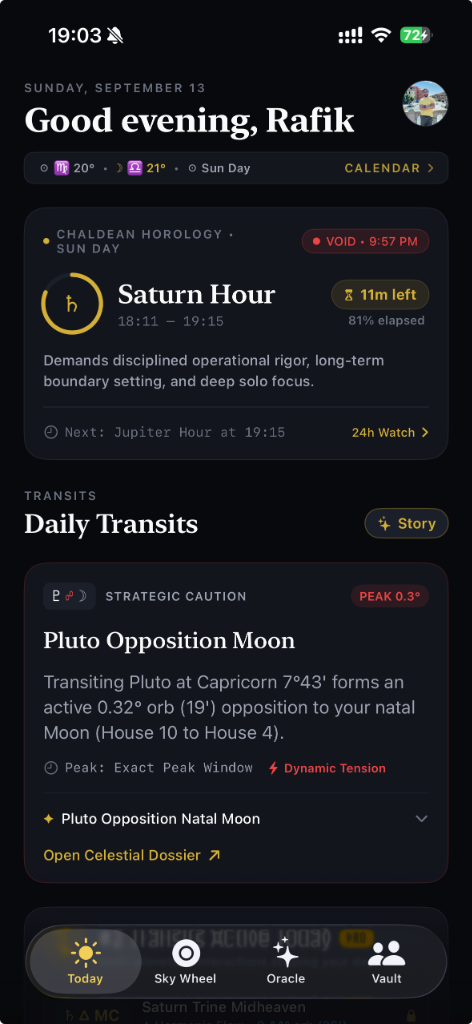
Orbital calculates these local solar events to the second based on your geographic coordinates, ensuring your live planetary clock is true to your horizon.